Completing a FarRide - excludes Fellowship Rides
A FarRide is not a race. There is no required average speed and nothing to be gained by finishing early.
A qualifying FarRide begins with a plan and ends with an honest record.
You then ride the chosen distance within the available time, meet any destination or check-in requirements and show us enough to support what you did.
Your ride. Your call.
You choose when to start, which roads to take, where to stop and whether to continue.
Your route, pace, rest, motorcycle, legal compliance, health and safety arrangements, all remain your responsibility.
Conditions change. Plans change. If pressing on stops making sense, stop. That decision needs neither permission nor apology.
FarRiders sets the criteria for recognising a ride. It does not decide whether you are ready, tell you how to ride, supervise the journey or monitor your safety. The distance, elapsed time and check-in requirements define the FarRide. They are not instructions to continue after common sense has left the building.
What counts as completed
Unless the ride description says otherwise, you need to:
register, where required;
ride at least the published distance within the available time;
attend the destination or check-in during the published window, where required;
keep a simple record using one of the available options (refer below); and
submit the outcome.
The clock runs from the recorded start to the recorded finish and is inclusive of travel time, fuel, food and rest stops.
Three possible outcomes
Completed
You rode the published distance within the available time and met the ride requirements. Subject to verification, it will be recognised and added to your FarRiders history as Completed.
Ride Concluded
You started but stopped and did not meet every requirement.
You recorded when and where you finished and the distance ridden, using the Finishing Form, regardless of documentation method used. The ride will be added to your history as Ride Concluded.
Withdrawn
You registered but did not start the ride and as a courtesy, you contacted the Ride Coordinator to let them know.
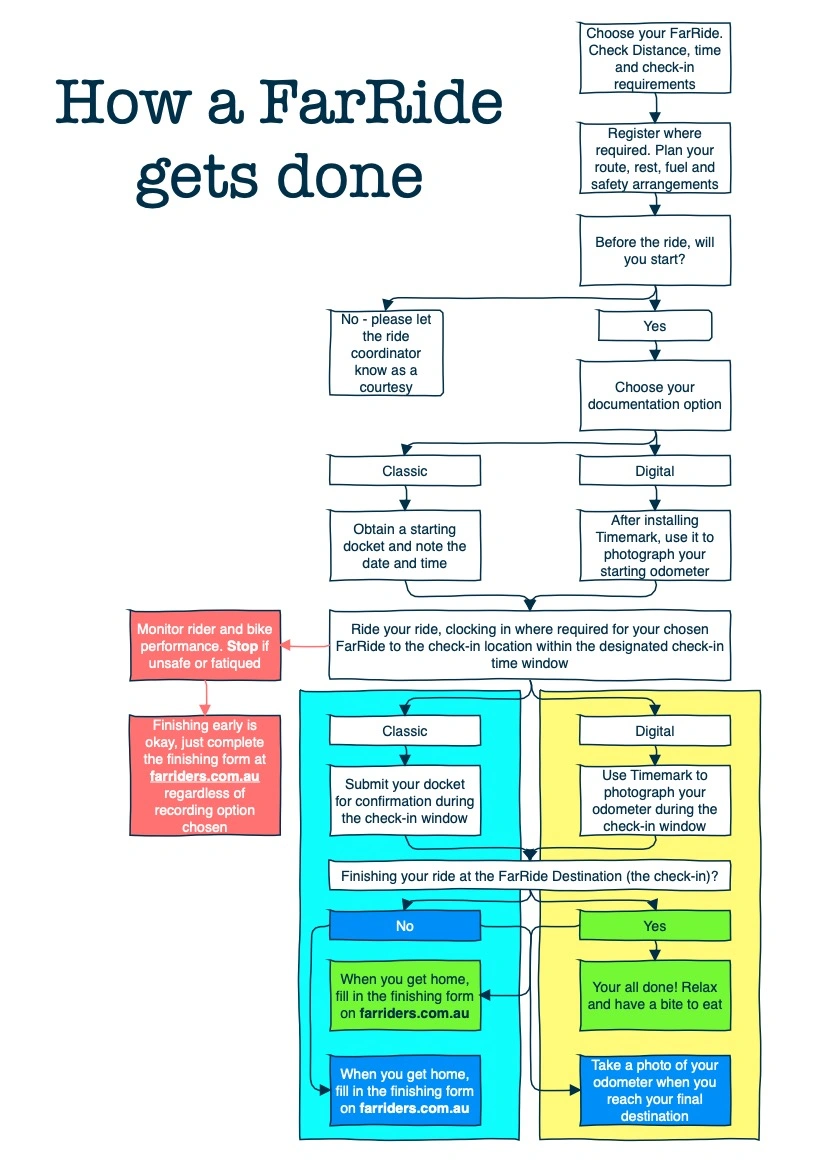
How to do a FarRide
So how do you complete a FarRide?
Easy - just follow this pathway.
It explains the process of registration, planning, choice of documentation method (refer below), riding and completing a FarRide by stepping you through the FarRiderFlowchart.
Safety arrangements
Your route. Your motorcycle. Your calls. Your wellbeing. Your safety plan.
FarRiders does not monitor riders or provide welfare, tracking or emergency-response services. Registration, destination check-ins, optional tracking links and ride submissions exist to administer and recognise rides. Nothing more. If you do not arrive, check in or submit an outcome, do not assume FarRiders will notice. Make your own check-in arrangements with someone you trust. If you need help, contact emergency services directly.
If information suggesting an emergency reaches FarRiders, we may pass it to emergency services or someone able to help. Responding to information received is not the same as monitoring your ride.
Privacy and ride information
Ride records may include your name, odometer photographs and precise time and location information. The Record Your Ride form links to the FarRiders Privacy Statement. It explains what we collect, why we collect it, who can access it, how long we keep it, what may appear publicly and how to request access or correction.
Read it before submitting. No surprises.
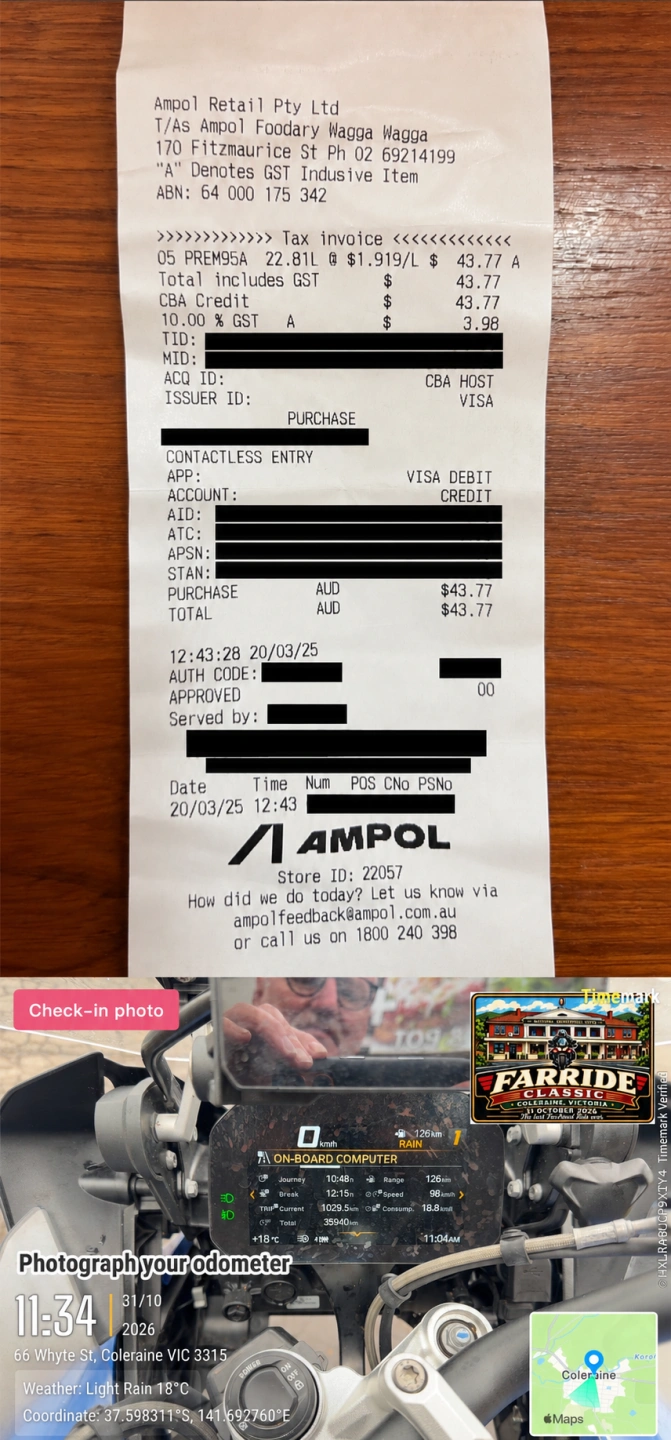
Ride Documentation Options
Choose whichever option works for you. They have equal standing.
Classic
Use a transaction docket showing the starting date, time and location.
When the ride ends, complete the finish form and provide the finishing location, time, odometer reading and distance.
No finish docket is required unless the ride description asks for one. A destination check-in may establish the finishing time, but the finish form must still be completed.
Keep extra dockets for corners, turn points or loops if the route might otherwise be unclear.
Digital
Use the TimeMark app to take GPS and time-stamped photographs of:
the starting odometer;
any required checkpoints; and
the finishing odometer.
TimeMark adds the date, time, time zone and location. FarRiders uses this information to determine the outcome and distance ridden.
Because TimeMark captures the required information, no separate finish form is needed.
Digital with tracking
Use Digital and add a SpotWalla trip or similar location history if you want to.
Tracking can preserve the story and help confirm the route. It is optional and is never monitored while you ride. If submitted, it may be reviewed afterwards solely to support recognition.
Nobody has to pay to participate.
How rides are recognised
We check four things:
Was the published distance completed?
Was it completed within the available time?
Were any destination or check-in requirements met?
Does the information supplied reasonably support the outcome claimed?
If something is missing or unclear, we ask. The point is to recognise genuine rides, not hunt for technicalities on which to reject them.
The ride is then recorded as:
Completed — with the relevant FarRide designation; or
Ride Concluded — with the distance achieved.
Distance counts. So do preparation, honesty, resilience and sound judgement.
Knowing when to stop is part of the ride—not a failure of it.